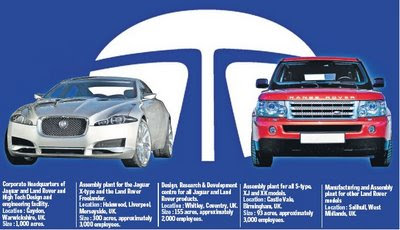
Tata Motors Buys Land Rover, Jaguar For $2.3 Billion!!!!
"Tata Motors has finally lapped up Jaguar and Land Rover from Ford Motor Co., the world’s third- largest automaker, for $2.3 billion, which is less than half what Ford paid for the two brands"
Counting losses and product development, analysts figure Ford spent more than $10 billion on the brands. Ford acquired Jaguar in 1989 for $2.5 billion and Land Rover in 2000 for $2.73 billion as part of a European-luxury strategy it began by buying Aston Martin in 1987. It sold Aston last year.
(Jaguar, which was founded in 1922 and Land Rover, founded in 1948 — the year after India gained its independence from Britain)
For the Tatas, it will be a challenge to turn around the luxury models. It has bought out two loss makiing luxury brands. Tata has obtained $3 billion for funidng the acquisition.
Tata said Ford will continue to supply engines, transmissions and other components for five to nine years. The Indian company said it expects no significant changes for Jaguar and Land Rover's 16,000 workers, and its statements said it would preserve the heritage of the brands.
"We have enormous respect for the two brands and will endeavour to preserve and build on their heritage and competitiveness, keeping their identities intact," Tata's chairman, Ratan Tata assured.
So Tata has decided to retain manufacturing of Jaguar and Land Rover in Britain, which may result in higher costs of production due to rising material prices in Western Europe.
"The biggest challenge for Tata Motors is to balance the increase in costs with tradition, quality and performance of Jaguar and Land Rover," -industry analyst.
Indian auto components makers may not gain immediate entry into the Jaguar and Land Rover plants acquired by Tata Motors, experts have said.
The sale of Jaguar and Land Rover is part of a radical reshaping of Ford, which is struggling to return to profitability in the face of crippling healthcare and pension costs and competition from foreign carmakers. Earlier this year, it sold Aston Martin and it is expected to sell Volvo, the Swedish car group.
"Tata Motors has finally lapped up Jaguar and Land Rover from Ford Motor Co., the world’s third- largest automaker, for $2.3 billion, which is less than half what Ford paid for the two brands"
Counting losses and product development, analysts figure Ford spent more than $10 billion on the brands. Ford acquired Jaguar in 1989 for $2.5 billion and Land Rover in 2000 for $2.73 billion as part of a European-luxury strategy it began by buying Aston Martin in 1987. It sold Aston last year.
(Jaguar, which was founded in 1922 and Land Rover, founded in 1948 — the year after India gained its independence from Britain)
For the Tatas, it will be a challenge to turn around the luxury models. It has bought out two loss makiing luxury brands. Tata has obtained $3 billion for funidng the acquisition.
Tata said Ford will continue to supply engines, transmissions and other components for five to nine years. The Indian company said it expects no significant changes for Jaguar and Land Rover's 16,000 workers, and its statements said it would preserve the heritage of the brands.
"We have enormous respect for the two brands and will endeavour to preserve and build on their heritage and competitiveness, keeping their identities intact," Tata's chairman, Ratan Tata assured.
So Tata has decided to retain manufacturing of Jaguar and Land Rover in Britain, which may result in higher costs of production due to rising material prices in Western Europe.
"The biggest challenge for Tata Motors is to balance the increase in costs with tradition, quality and performance of Jaguar and Land Rover," -industry analyst.
Indian auto components makers may not gain immediate entry into the Jaguar and Land Rover plants acquired by Tata Motors, experts have said.
The sale of Jaguar and Land Rover is part of a radical reshaping of Ford, which is struggling to return to profitability in the face of crippling healthcare and pension costs and competition from foreign carmakers. Earlier this year, it sold Aston Martin and it is expected to sell Volvo, the Swedish car group.


